

Description
Mokhai is an open-source WordPress plugin that turns your site into a first-class citizen of the AI-agent web — readable today, actionable next. A single Context Profile (configured once under Tools Context) is the source of truth for every agent-facing surface — what’s exposed, how it’s served, and how it’s scored.
Mokhai ships seven coherent modules, all driven by one Context Profile:
- Markdown Views — deterministic HTML Markdown rendering for any public URL, with three URL forms (
.mdpath,?format=mdquery,Accept: text/markdowncontent negotiation) and uniform 404 on denial. Per-post cache with content-hash invalidation, Gutenberg sidebar preview, WP-CLI command, REST endpoint for admin tooling. - LLMs Index —
/llms.txtgenerator that publishes a discovery surface for AI agents, with conflict detection againstrobots.txt, an editorial entries admin UI for site owners to add curated entries, and an optional LLM-powered pass that drafts entry descriptions from post content. - Context Score — 0–100 readiness audit across seven weighted sub-scores (discoverability, description coverage, schema coverage, exposure safety, integration health, Markdown conversion quality, multi-channel discovery), surfaced in an admin page, Site Health, and
wp ai-readiness-kit context-score recompute. Includes an optional LLM-generated narrative (with a rule-based fallback) explaining the score and the highest-leverage fixes. - Schema Coordination — detects whether your SEO plugin already emits JSON-LD; if not, optionally emits a native WebSite + Organization + per-content schema set so the schema sub-score is achievable without a third-party SEO plugin. Defers gracefully when an SEO plugin is already covering the surface.
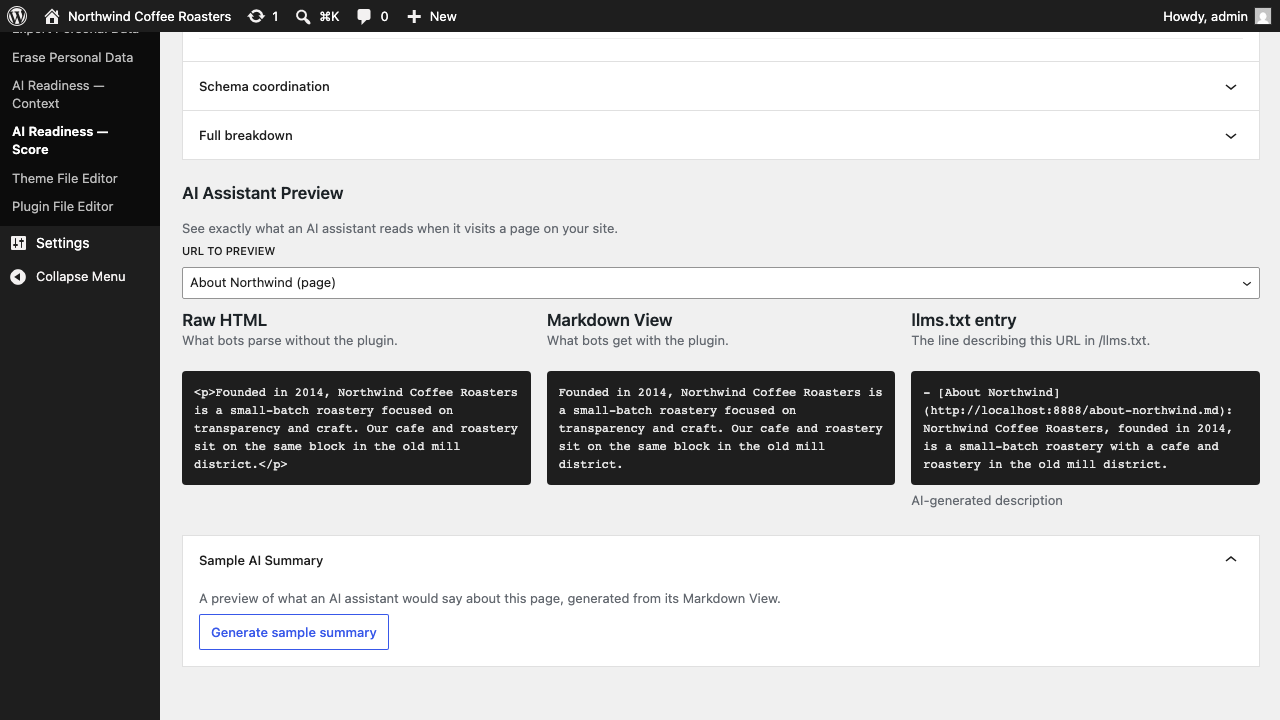
- AI Assistant Preview — an admin pane that shows any post exactly as an AI assistant consumes it: raw HTML, the Markdown View, and the live
/llms.txtline side by side, plus an on-demand “sample AI summary” so you can sanity-check what an agent would say about the page. - Agent Abilities + MCP — exposes core plugin operations (audit run, profile read, exposure toggle,
/llms.txtregenerate, Markdown preview) through the WordPress Abilities API, and surfaces them to MCP clients via the WordPress MCP adapter. Every ability ismanage_options-gated. - Multi-channel discovery — a seventh Context Score sub-score crediting additional agent-discovery surfaces (
ai.txt,/.well-known/declarations, OpenAPI) beyond/llms.txt, so a site running several discovery channels scores higher than one running only one.
The plugin is fully free, GPL-2.0+, with no paid tier and no hosted backend. Every module is independently toggleable from the Context Profile. No content leaves your server. The plugin makes no external HTTP calls; AI providers configured via the WP AI Client (an optional dependency) are only consulted by modules that explicitly opt in, and every deterministic surface (Markdown Views, /llms.txt, the rule-based score, the gap-fill schema) runs fully locally without an AI provider.
Markdown Views
Markdown Views exposes any public URL as a clean Markdown variant. The intended consumer is an AI agent that’s discovered a URL (typically via /llms.txt) and wants the raw content without HTML chrome, header/footer/sidebar markup, or JavaScript-rendered widgets.
Three URL forms
All three return the same body. Pick whichever matches your client.
https://example.com/about-us.md— path-form (requires pretty permalinks; aligned with the llms.txt ecosystem convention)https://example.com/about-us/?format=md— query-form (works regardless of permalink structure)Accept: text/markdownheader on the canonical URL — content-negotiation form
The 200 response always carries Content-Type: text/markdown; charset=utf-8, X-Robots-Tag: noindex (so search engines don’t index the raw view as a duplicate of the HTML), and Cache-Control: no-store, must-revalidate.
Exposure rules
A URL returns 404 with no body — never a partial content leak — when any of the following is true:
- The post’s CPT is not in the Context Profile’s “Exposed CPTs” list
- The post’s status is not in the “Exposed statuses” list (defaults to
publishonly) - The post is password-protected
- A subscriber to the
agentready_post_is_noindexedfilter returns true (the extension point for SEO-plugin noindex coordination — wire it from your theme / a companion plugin in v0.1; native Yoast / Rank Math / AIOSEO subscribers ship in a follow-up release) - The Markdown Views module is toggled off in the Context Profile
All denial paths produce the same 404 shape — admin debugging via the REST endpoint or the wp ai-readiness-kit md preview command surfaces the specific reason.
Inspection surfaces
- Gutenberg sidebar panel — opens automatically in the document settings sidebar when editing a post. Shows the current MD rendering, the visibility verdict, and the cache state (cached vs miss, walker version, generated_at).
- WP-CLI —
wp ai-readiness-kit md preview <post-id-or-url>. Supports--format=wrappedfor YAML-front-matter output suitable for piping into LLM tooling,--show-metafor cache diagnostics on stderr, and--bypass-exposure(requires manage_options) for inspecting hidden posts without serving them. - REST endpoint —
GET /wp-json/ai-readiness-kit/v1/markdown-views/preview?post=<id>. Authentication via WP cookie / nonce; permission gated onedit_postfor the target post. Used by the Gutenberg sidebar; available to third-party admin tooling.
LLMs Index (/llms.txt)
Mokhai publishes a /llms.txt discovery surface for AI agents — the de-facto convention for declaring which URLs on a site are worth fetching as agent context. The generator is driven by the Context Profile: only CPTs and statuses you’ve exposed appear in the index. Conflict detection surfaces when robots.txt already covers the same paths; an admin notice points to the conflict so coverage isn’t silently inconsistent.
Editorial entries
Most sites have URLs that aren’t WordPress posts but are valuable agent context — pricing pages, brand guidelines, support knowledge bases hosted elsewhere. The editorial entries admin UI lets site owners add curated entries with custom titles and descriptions; they appear in /llms.txt alongside the auto-generated post entries.
LLM-powered descriptions
Optionally, an LLM pass drafts the per-entry descriptions from the post content (uses the WP AI Client provider configured at the site level). The deterministic floor — title-only, no description — runs without an AI provider.
Posts whose body is below a minimum length are skipped by the LLM pass rather than padded with filler (e.g. a bare “Title is available at URL.”). Such entries show a “skipped” status in the Descriptions tab and fall back to the title-only floor in /llms.txt. Adjust the threshold with the agentready_description_min_content_chars filter.
WP-CLI
wp ai-readiness-kit llms-txt status— current generation state, conflict report, entry countwp ai-readiness-kit llms-txt regen— force regenerationwp ai-readiness-kit llms-txt preview— output the current/llms.txtcontent to stdout
Context Score
Context Score is the 0–100 readiness audit answering “how prepared is this site for AI agent traffic?”. It combines seven weighted sub-scores:
- Discoverability (weight 10) —
/llms.txtcache populated, at least one CPT exposed, entries published, no rewrite conflicts overriding the route - Description coverage (weight 15) — share of exposed entries that have a curated description (post excerpt or LLM-generated cache from the descriptions module)
- Schema coverage (weight 10) — JSON-LD is being emitted, either by a detected SEO plugin (Yoast / Rank Math / AIOSEO / The SEO Framework) or by Mokhai’s native gap-fill emitter when the Context Profile toggle is on
- Exposure safety (weight 15) — exposed statuses are limited to
publish(no risky non-publish exposures) and at least one CPT is configured explicitly rather than implicitly - Integration health (weight 15) — LLM features AI Client posture are consistent (no silent-degrade trap) and no
/llms.txtconflicts are unresolved - Markdown conversion quality (weight 25) — mean quality score across the Markdown Views cache and the percentage of cached posts above the cleanup threshold
- Multi-channel discovery (weight 10) — how many of the four plugin-served agent-discovery surfaces are present (
/llms.txt,ai.txt,/.well-known/ai-layer,/.well-known/llms-policy.json); all four = 100, so a plugin-only site can reach full marks. OpenAPI is detected and credited as a bonus channel for sites exposing an API but does not change the score. Sibling-provider plugins (e.g. AI Layer) are detected and credited via the filterableai_readiness_kit_multi_channel_providersregistry.
The score is surfaced in three places:
- Tools Context Context Score — the full breakdown with per-sub-score detail
- Site Health — the headline score and the highest-leverage area to improve
- WP-CLI —
wp ai-readiness-kit context-score recomputefor scripted audits
An LLM-generated narrative (uses the WP AI Client provider) explains the score in plain English and names the highest-leverage fixes. A rule-based narrative ships as a fallback for sites without an AI provider configured.
Schema Coordination
When you have an SEO plugin (Yoast, Rank Math, AIOSEO, The SEO Framework) active and emitting JSON-LD, Mokhai defers schema emission to them entirely — no competing markup, no duplicate type declarations. When no SEO plugin is emitting schema, Mokhai can optionally emit a native WebSite + Organization + per-content schema set so the schema sub-score in Context Score is achievable without a third-party SEO plugin. The toggle lives in the Context Profile; default is off (gap-fill behaviour kicks in only when explicitly enabled).
AI Assistant Preview
The AI Assistant Preview pane (Tools Context) answers a question every site owner eventually asks: “what does an AI assistant actually see when it reads this page?” Pick any exposed URL and the pane renders three views side by side — the raw HTML, the Markdown View an agent fetches (proxied through the same converter as the live .md surface, so the no-hallucination guard applies), and the exact /llms.txt line for that entry. A “Sample AI Summary” box generates an on-demand, synchronous summary using the configured WP AI Client provider (no cron, no background queue — it runs and caches in place), so you can sanity-check the agent’s-eye view of a page before publishing. The summary degrades gracefully (a structured hint, never a raw error) when no AI provider is configured.
Agent Abilities (MCP)
Mokhai registers an ai-readiness-kit ability category and five core WordPress Abilities (WP 6.9+): audit-run, profile-read, profile-set-exposure, llms-txt-regenerate, and md-view-preview. Each is a thin wrapper over an existing service, gated on manage_options, and exposed via the core wp-abilities/v1 REST surface. When the WordPress MCP adapter is installed, these abilities are also reachable by MCP clients (the abilities are flagged meta.mcp.public), making the plugin’s operations callable by agent runtimes — a step from agent-readable toward agent-usable. The MCP flag is inert when no adapter is present, so the abilities work standalone.
Privacy and Storage
Mokhai stores rendered Markdown in a custom table named {$wpdb->prefix}agentready_md_cache, with one row per published post that has been requested at least once as Markdown — holding the Markdown body, an integrity hash of the source content, and the timestamp at which it was generated. The cache is invalidated automatically when a post is saved, trashed, or deleted.
Context Score audit results are cached in the agentready_context_score_cache wp_options entry (the most-recent breakdown only — overwritten on each recompute).
No content leaves your server. The plugin makes no external HTTP calls and ships no third-party analytics. AI providers configured via the WP AI Client (an optional dependency) are only consulted by modules that explicitly opt in; the deterministic surfaces (Markdown Views, /llms.txt, rule-based score narrative, gap-fill schema) all run fully locally without an AI provider.
Both cache tables are dropped on plugin uninstall (not on deactivation — deactivate is reversible, uninstall is the explicit “I’m done” gesture).
Configuration
Under Tools Context, set:
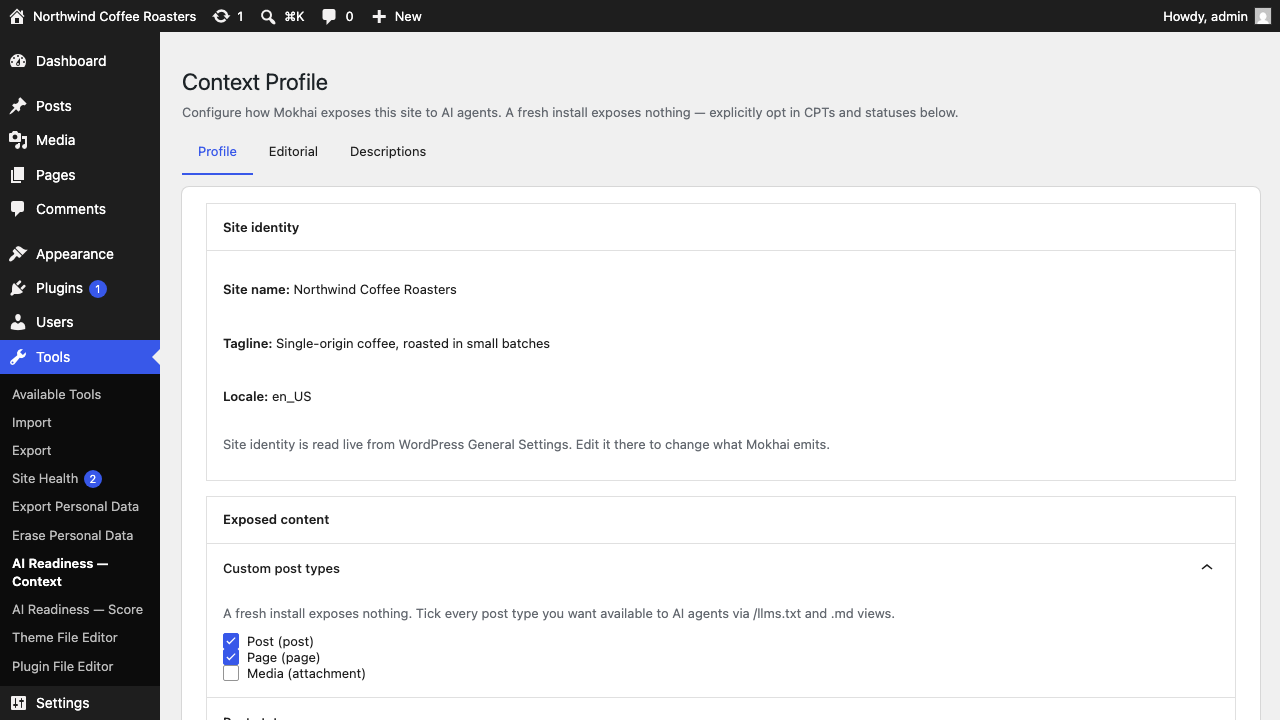
- Exposed CPTs — the list of post types to expose to agents. Default: empty (safe-by-default — a fresh install exposes nothing).
- Exposed statuses — the list of post statuses to expose. Default:
publishonly.
The same screen exposes the LLM cleanup toggle (Markdown Views auto-cleanup pass), the LLM descriptions toggle (auto-drafted /llms.txt entry descriptions), and the native Schema emission toggle (default off — opt in to satisfy Context Score’s schema sub-score without a third-party SEO plugin). Each toggle gracefully degrades when the WP AI Client is unconfigured.
To turn Markdown Views off without uninstalling:
wp eval "$p = get_option('agentready_context_profile'); $p['markdown_views_enabled'] = false; update_option('agentready_context_profile', $p);"
The module respects the toggle without latency — flipping back to true is instant; the cache table is preserved across toggle cycles.
Screenshots
/llms.txt line, side by side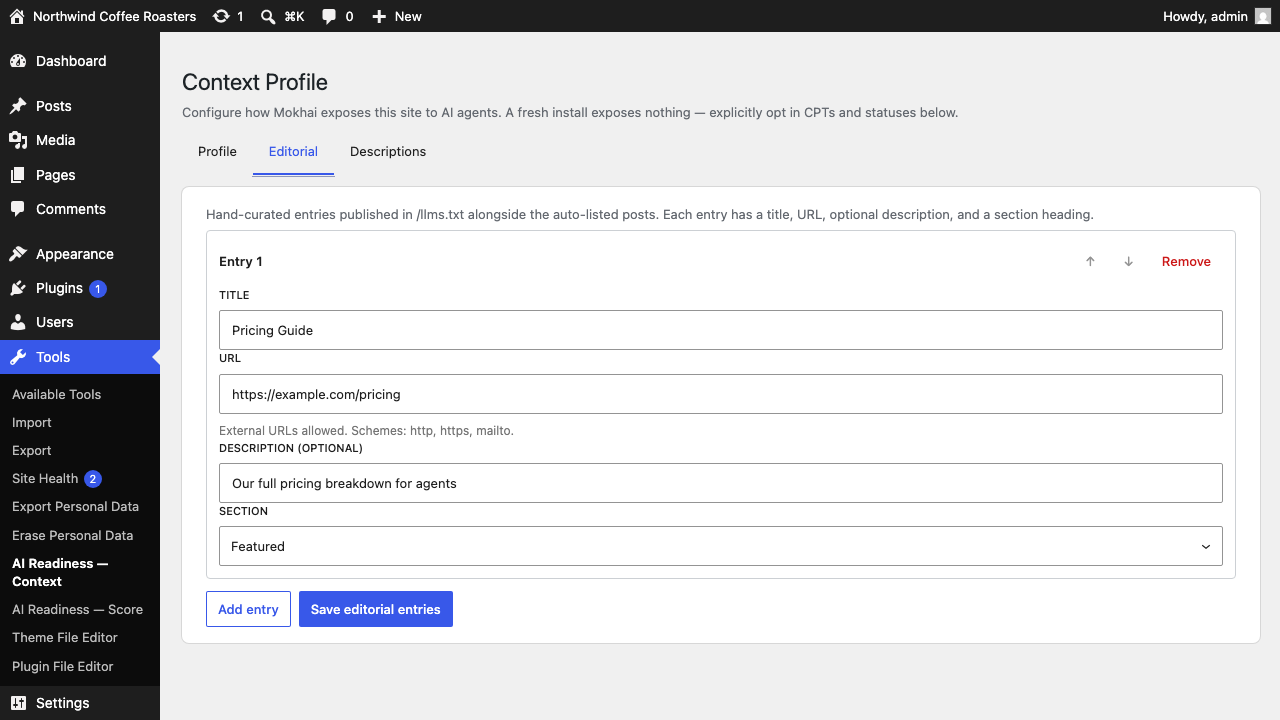
/llms.txt admin UI with editorial entries and LLM-powered descriptions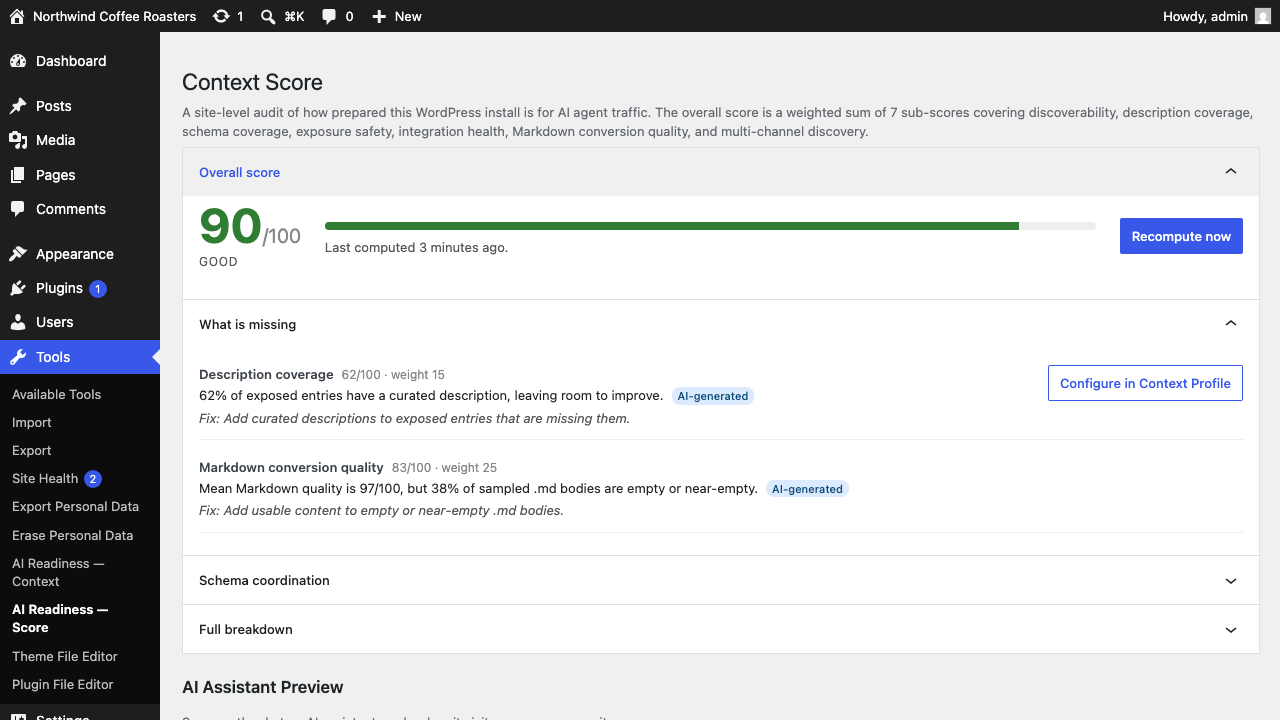
FAQ
Does Mokhai require an AI API key?
No. Every deterministic surface (Markdown Views, /llms.txt floor, rule-based Context Score narrative, gap-fill JSON-LD emission) runs fully locally with no external calls. Modules that benefit from an LLM (the Markdown cleanup pass, /llms.txt entry-description drafting, the LLM-narrated Context Score) require the optional WP AI Client to be configured, but each is independently toggleable and not load-bearing for the core agent-readiness contract.
How does Mokhai interact with my SEO plugin?
For JSON-LD: when an SEO plugin (Yoast, Rank Math, AIOSEO, The SEO Framework) is active, Mokhai emits nothing competing — schema is theirs. When no SEO plugin is emitting JSON-LD, you can optionally enable Mokhai’s native gap-fill emission from the Context Profile. For noindex: Mokhai ships an
agentready_post_is_noindexedfilter the Markdown Views handler honours; v0.1 leaves the SEO-plugin subscriber unwired (a theme or companion plugin can subscribe it today; native Yoast / Rank Math / AIOSEO subscribers ship in a follow-up release).How is this different from existing /llms.txt plugins?
/llms.txt is one surface among several. Mokhai ships the integrated reading layer (Markdown views), the discovery layer (/llms.txt with editorial entries and LLM-powered descriptions), the audit layer (Context Score across seven sub-scores), and the schema coordination layer as a single coherent unit driven by one Context Profile. Most existing plugins target one of these surfaces in isolation; Mokhai treats them as a coordinated stack.
What’s on the roadmap after v0.2?
v0.2 shipped the AI Assistant Preview pane, the WordPress Abilities API + MCP integration, and the multi-channel discovery sub-score. Looking ahead: a fuller agent-actionable layer (callable tools via WebMCP /
navigator.modelContext), agent-activity analytics (per-bot counters), and a richer/.well-known/llms-policy.jsonpolicy-declaration surface.
Reviews
There are no reviews for this plugin.
Contributors & Developers
“Mokhai – Agent Readiness Kit” is open source software. The following people have contributed to this plugin.
Contributors
Translate “Mokhai – Agent Readiness Kit” into your language.
Interested in development?
Browse the code, check out the SVN repository, or subscribe to the development log by RSS.
Changelog
0.4.0 — 2026-06-29
Public-launch release. The plugin is now live on the WordPress.org Plugin Directory as “Mokhai – Agent Readiness Kit” (slug mokhai-agent-readiness-kit). This release is launch housekeeping — no functional change, no migration:
- Refreshed Plugin Directory assets — new banner, icon, and screenshots.
- Polished readme copy for the public listing.
- Repository links consolidated under the
mokhai-agent-readiness-kitname (Plugin URI, package metadata). REST routes, WP-CLI commands, abilities, option keys, and all stored data are unchanged — existing installs upgrade in place with no action required.
0.3.2 — 2026-06-21
Rename to “Mokhai – Agent Readiness Kit” (text domain mokhai-agent-readiness-kit). wp.org plugin review rejected “Agentable” as colliding with existing third-party projects and required a name and slug that are clearly ours, with a distinctive leading term. “Mokhai” satisfies that. REST, WP-CLI, abilities, option keys, and all stored data are unchanged — existing installs upgrade with no migration. (#259, AgDR-0062)
Also ships the following changes that landed on main since 0.3.1:
/llms.txtnow warns in the admin when a staticrobots.txtblocks the/llms.txtreference, so the conflict isn’t silent. (#245, #250)/llms.txtemits the site header on an otherwise-empty index instead of returning a blank body. (#244, #249)- WooCommerce transactional pages (cart, checkout, account) are now excluded from the
/llms.txtindex. (#243, #248) - Markdown Views falls back to the raw
post_titlewhen a filtered title comes back empty, so titled posts no longer render untitled. (#242, #247) - Markdown URL mapper now guards the root / front-page URL, fixing mapping on the home route. (#241, #246)
0.3.1 — 2026-06-14
Rename to Agentable (text domain agentable). The previous “AgentReady” brand collided with an existing third party (agentready.org), so the plugin is renamed to a distinct, ownable name that also fits the roadmap — sites readable today, actionable next. REST, WP-CLI, abilities, and stored data keys are unchanged, so existing installs upgrade with no migration. Also makes root-served-file detection (llms.txt, ai.txt, .well-known/*) subdirectory-install aware via get_home_path() instead of assuming the install root is the web root. (#230, AgDR-0060)
0.3.0 — 2026-06-12
Polish release. Refinements surfaced through a full live UX walkthrough of the v0.2.0 admin surfaces — score-narrative correctness, clearer labels, and a more discoverable plugin. Also renamed to “AgentReady – AI Readiness Kit”; REST, WP-CLI, and stored data keys are unchanged. (#224, AgDR-0059)
Improved
- Multi-channel discovery is reachable at 100 for plugin-only sites — the four plugin-served discovery channels (
/llms.txt,ai.txt,/.well-known/ai-layer,/.well-known/llms-policy.json) now score 100 on their own; OpenAPI is credited as a bonus channel for API-exposing sites rather than capping the score at 80. (#212, AgDR-0058) - “Content readability” renamed to “Description coverage” across the Context Score page, Site Health, and readme, to match what the sub-score actually measures (curated
/llms.txtdescription coverage). Internal key unchanged. (#211) - Plugin is now findable in wp-admin — the Tools entries read “AI Readiness — Context” / “AI Readiness — Score”, and the Plugins list carries a “Settings” link to the Context Profile. (#207)
- Quality floor for auto-descriptions — near-empty posts are skipped (distinct “skipped” status) instead of padded with filler like “Title is available at URL.”; threshold filterable via
agentready_description_min_content_chars. (#214)
Fixes
- Schema-coverage narrative no longer reads “No structured data was detected” beside a 100/100 score when native JSON-LD emission is on; the stale “future release” fix advice is replaced with the reachable Context Profile action. (#208)
- Content-readability fix advice now points to the Descriptions tab “Regenerate stale descriptions” GUI path and stops telling users to enable a setting that is already on. (#209)
- The multi-channel discovery sub-score renders a human label instead of the raw
multi_channel_discoverykey. (#210) - AI Assistant Preview shows an explicit “no content” message for empty posts instead of blank dark panes. (#213)
- Relative-time copy uses proper
_n()plural forms (“1 minute ago” / “5 minutes ago”); excluded posts in the Descriptions table are labelled “excluded” and the intro copy matches. (#215)
0.2.0 — 2026-06-03
Feature release. Three new agent-facing modules plus a batch of correctness fixes surfaced through live testing.
New
- AI Assistant Preview pane — view any post as an AI assistant consumes it (raw HTML / Markdown View / live
/llms.txtline, side by side) with an on-demand synchronous “sample AI summary”. No cron; degrades gracefully without an AI provider. (#45) - WordPress Abilities API + MCP — five
manage_options-gated abilities (audit-run, profile-read, profile-set-exposure, llms-txt-regenerate, md-view-preview) exposed via corewp-abilities/v1, and reachable by MCP clients through the WordPress MCP adapter when installed. (#21, #131) - Multi-channel discovery sub-score — Context Score gains a seventh sub-score crediting agent-discovery surfaces beyond
/llms.txt(ai.txt,/.well-known/declarations, OpenAPI), with a filterable sibling-provider registry. Discoverability re-weighted 20 10 to fund it; total stays 100. (#22)
Improved
- Tools Context rebuilt as a single Card + TabPanel single-page admin, aligned with the WP AI Client / OpenAI Connector design system, with REST write controllers for the Context Profile and editorial entries. (#142)
- Context Score reason strings are now fully translatable via reason codes, and the sub-score copy across the admin UI and the LLM narrative prompt derives from a single source of truth (
Engine::WEIGHTS). (#137, #139, #140)
Fixes
- JSON-LD is now emitted without
esc_html()(angle brackets escaped viaJSON_HEX_TAG), so the structured-data payload validates in every standards-compliant validator. (#118) - Stale past-timestamp cron events are cleared before re-scheduling across all four schedulers (
/llms.txtrecompute, Context Score recompute, Markdown cleanup, description generation) — fixes “stuck pending forever” on sites where wp-cron sat stale. (#115, #120, #121) - The Markdown cleanup allowlist now preserves word boundaries at block edges, so headings and paragraphs adjacent to block tags are no longer dropped by the no-hallucination guard. (#135)
- Orphaned shortcodes are stripped from both the deterministic Markdown walker and
/llms.txtentry descriptions via a shared helper. (#145, #147) /llms.txtnow recomposes when a post’s description changes, and carries a generator-version staleness signal so out-of-date descriptions are detectable. (#149, #151)package.jsonversion now tracks the plugin version (was drifting at 0.1.0). (#113)
0.1.1 — 2026-05-24
Bug-fix release. Four issues surfaced during post-merge smoke testing of v0.1.0 (PR #102 rebrand bundle) and the external LLM review of the live /llms.txt output.
Fixes
/llms.txtregen now fires reliably after Context Profile saves on sites where wp-cron sits stale (e.g. wp-env without traffic, any site where cron failed for a window).Service::schedule_regen()now clears stale past-timestamp events before scheduling a fresh one. (#103)Schema_Emitternow emits per-content JSON-LD for custom CPTs. Built-inpostmaps toArticle;pageand every other CPT (including custom ones likelesson,product,recipe) map toWebPageby default. Adds anagentready_schema_type_for_cptfilter for plugin/theme authors to specialize. Honors'Article'/'WebPage'/null(suppress) in v0.1.1; full custom-@typesupport lands in v0.1.2. AgDR-0040 captures the rationale. (#104)/llms.txtentry links now point at the.mdform when Markdown Views is enabled — AI agents fetch a 4–8 KB Markdown body instead of the 50–100 KB HTML page. Pretty permalinks use the<slug>.mdshape; plain permalinks fall through to?format=md. Idempotent: URLs already in either form are returned unchanged. Whenmarkdown_views_enabledis false, the canonical permalink is preserved. (#105)- HTML entities (
’,&,",—, etc.) no longer leak into the plain-text/llms.txtbody. WordPress’swptexturizefilter HTML-encodes typographic characters; the composer now decodes them at the bottom of the escape pipeline so every text surface (site name, tagline, section label, entry title, description) is clean. (#106)
0.1.0 — 2026-05-20
First public release. Four coherent modules driven by one Context Profile.
Markdown Views
- Deterministic HTML Markdown rendering with three URL forms (path
.md, query?format=md,Accept: text/markdown) - Custom cache table with content-hash invalidation and walker-version lazy revalidation
- Gutenberg sidebar panel for in-editor preview
wp ai-readiness-kit md previewWP-CLI command with--format=wrapped,--show-meta,--bypass-exposure- REST endpoint for admin tooling at
/wp-json/ai-readiness-kit/v1/markdown-views/preview - LLM cleanup pass with safety guard (rate-limited, opt-in via Context Profile)
- Admin UI for cleanup approval workflow
LLMs Index (/llms.txt)
/llms.txtgenerator with Context Profile-driven inclusion rules- Conflict detection against
robots.txtwith admin notice - Editorial entries admin UI for curated non-WordPress URLs
- LLM-powered per-entry descriptions (Phase A engine + Phase B admin UI)
- WP-CLI:
wp ai-readiness-kit llms-txt {status,regen,preview}
Context Score
- Six weighted sub-scores (discoverability 20, content readability 15, schema coverage 10, exposure safety 15, integration health 15, Markdown conversion quality 25) 0–100 composite
- Admin page at Tools Context Score with full sub-score breakdown
- Site Health integration with headline score and highest-leverage fix surfacing
- REST endpoint for programmatic access
- LLM-narrated explanation with rule-based fallback
- WP-CLI:
wp ai-readiness-kit context-score recompute
Schema Coordination
- SEO plugin detection (Yoast, Rank Math, AIOSEO, The SEO Framework)
- Native gap-fill JSON-LD emitter (WebSite + Organization + per-content) gated behind a Context Profile toggle, credited in Context Score’s schema sub-score
Infrastructure
- Layered CI: PHPCS (WordPress + WordPressVIPMinimum) + Plugin Check + PHPUnit + PHPStan level 5
requires_wp/requires_phpruntime gate with admin-notice degradation- Translation policy documented (AgDR-0009): managed via wp.org under slug
agentable - Competitive landscape captured (AgDR-0006)